Improving Goal Concordant Care Initiative
In September 2020, the ADCC launched a collaborative project called the Improving Goal Concordant Care (IGCC) Initiative. Collectively, our cancer hospitals embraced the vision that all patients with cancer and their families should receive care that aligns with their values and unique priorities.
To realize this vision, we believe that primary oncology teams must take responsibility for ensuring the timely initiation and ongoing conversations regarding goals of care for their patients. However, we recognized that oncologists need enhanced training and an enabling practice infrastructure to achieve reliable, effective, and efficient goals-of-care conversations.
The IGCC was a three-year initiative (September 2020-December 2023) designed to address system gaps across our centers and to establish new expectations for when and how goals-of-care conversations occur. IGCC’s conceptual development was led by palliative care and oncology experts across our 10 cancer centers, and guided by patient and family advisors.
The IGCC core components are:
- A formal communications skills training program for hematologists/oncologists and collaborating advanced practice professionals. Training must integrate one of the proven, existing programs for goals-of-care communications education, or adopt established key learning domains and rigorous training methods.
- Structured goals-of-care documentation in electronic health records, including a minimum set of structured fields and functionality to promote access and retrieval across providers and settings
- Expectations regarding the patients who are prioritized to receive goals-of-care discussions, and timing for communication
- An evaluation and measurement framework
Main findings and lessons learned are described in the publications below.
IGCC Publications
Access the article, Integrating Goals-of-Care Documentation Into the Electronic Health Record: Three-Year Results and Insights of the Improving Goal Concordant Care (IGCC) Initiative Across 10 Cancer Centers, published in JNCCN, July 2026
Access the article, Implementation of Structured Oncologist Communication Skills Training within the Improving Goal Concordant Care Initiative: Lessons Learned and Future Progress, published in J Palliat Med, May 7, 2026
Access the article, ADCC’s Improving Goal Concordant Care Initiative: Implementing Primary Palliative Care Principles, published in Journal of Pain and Symptom Management (JPSM), May 2023
Access the article, Improving Goal Concordant Care Among Ten Leading Academic US Cancer Hospitals: A Collaboration of the Alliance of Dedicated Cancer Centers, published in The Oncologist, June 2021
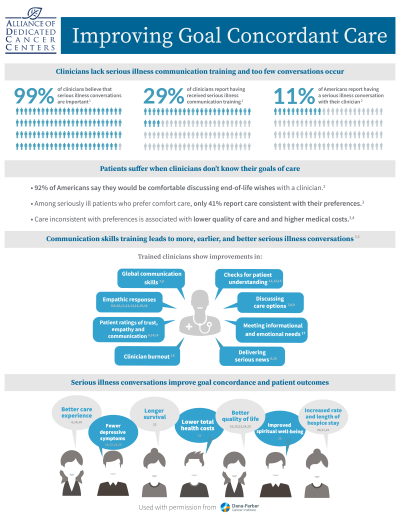
The infographic on this page summarizes the need for IGCC, including relevant literature, and the potential to improve patient outcomes. IGCC seeks to reduce suffering, improve the illness experience, and measurably enhance the lives of patients and families throughout the course of cancer.